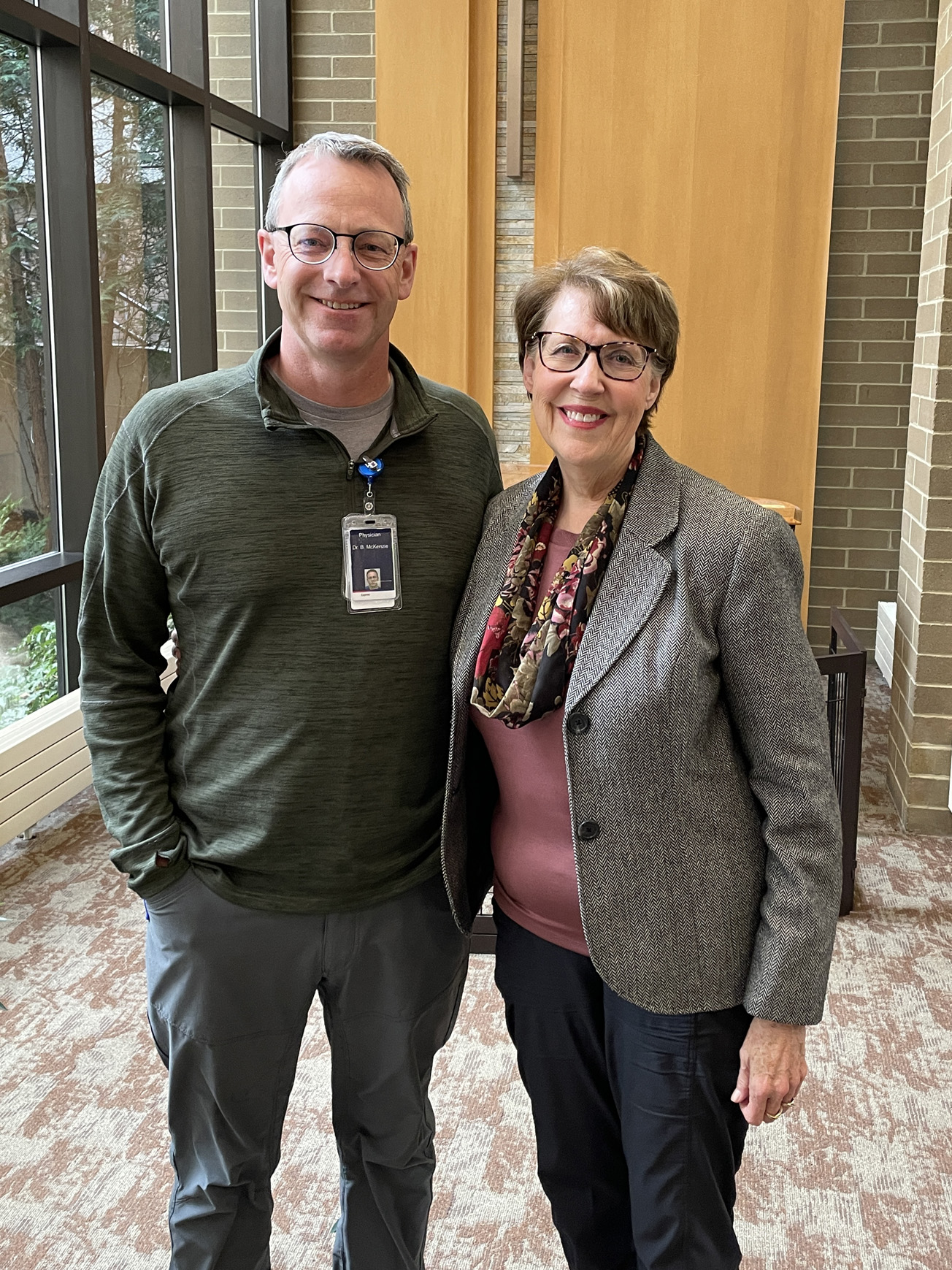
After losing her husband of more than 50 years, Trudy Carey was navigating life largely on her own. Even in the midst of grief, the Billings, Mont., resident kept a promise to herself to stay on top of her health — a decision that led to an unexpected colon cancer diagnosis caught early, when treatment options were best.
“When you’ve been married for 50 years, you have your person. And it’s hard when you have to ask friends for help,” Carey said.
Despite dealing with her grief and relying on friends and family, Carey scheduled her screening colonoscopy for colon cancer, knowing she would need someone to stay with her and drive her home after the short procedure.
During the procedure, doctors found a small abnormal area and sent the tissue for testing. Carey wasn’t initially concerned and “never gave it another thought.” She received a surprising call from the Intermountain Health Gastroenterology team a few days later.
“They said, ‘We have the results, and it’s cancer, and you need to get in right away for a CT scan,’” she said. She received imaging the next day and met with general surgeon Barry McKenzie, MD, at Intermountain Health St. Vincent Regional Hospital to discuss her options.
“The earlier we find colon cancer, the more options patients have, and the better the outcomes,” Dr. McKenzie said. “Early screening lets us detect cancer before symptoms start, and when cancer is caught early, it can often be treated through surgery alone.”
Dr. McKenzie performed a robotic-assisted, minimally invasive colon surgery on Jan. 23. Robotic-assisted approaches, which are now common for this type of surgery, allow surgeons to operate through small incisions with improved visualization and precision compared with traditional open surgery, which may support faster recovery for some patients. Carey said the minimally invasive approach mattered as she prepared to recover largely on her own.
“There’s just a lot of stress that goes with the recovery, especially on my own, and I was able to manage fine,” she said. “I healed up amazingly well and I haven’t had any problems with how the colon operates or what I could eat or anything.”
Her pathology results also brought relief. “The 16 lymph nodes were free and clear. I didn’t have to have any additional cancer treatment, like chemotherapy,” Carey said. She now plans another colonoscopy in a year as recommended by her physician as a follow-up.
Carey’s experience is a reminder that colorectal cancer can develop without warning signs, and that screening can detect cancer early, when it is most treatable.
As she continues to grieve the loss of her husband and recover from her diagnosis and surgery, Carey has stayed focused on preventive care and rebuilding her strength both physically and emotionally, and even with a sense of humor. “This is a pun now, but I am pretty anal about my health,” she said, explaining why she keeps up with screenings and why she joined a gym to stay active.
“I try to walk 15,000 to 20,000 steps a day, and I try to leave my house every day and go somewhere to make sure that I have the mental stimulation,” she said. “At this point, I’d rather be with my husband, but I’m also a very healthy 70-year-old. I am in extremely good health. I just have cancer. And I have very good mental health. I just miss my husband.”
Carey hopes her story will encourage others to take a similar approach to life and their health. “I just think it’s incumbent upon a person to take care of their own personal health,” she said. “We’re all responsible for ourselves and our actions. And I think having screenings, even when you’re older, to make sure that you can stay as healthy as possible is one of the responsible things you can do.”
Colorectal cancer screening is recommended for most adults starting at age 45. There are several effective ways to screen: a stool-based test done at home (such as a yearly FIT test or a stool DNA test every one to three years) or a colonoscopy, which is typically repeated every 10 years if results are normal. If a stool test is abnormal, a follow-up colonoscopy may be necessary. People with higher risk, including family history, certain genetic conditions, inflammatory bowel disease, or prior polyps, may need to start earlier or screen more often. It’s important for individuals to speak with their doctor to discuss the most appropriate option.
About Intermountain Health
Headquartered in Utah with locations in six states and additional operations across the western U.S., Intermountain Health is a nonprofit system of 34 hospitals, approximately 400 clinics, medical groups with some 4,600 employed physicians and advanced care providers, a nonprofit health plan called Select Health with more than one million members, and other health services. Helping people live the healthiest lives possible, Intermountain is committed to improving community health and is widely recognized as a leader in transforming healthcare by using evidence-based best practices to consistently deliver high-quality outcomes at sustainable costs. For up-to-date information and announcements, please see the Intermountain Health newsroom at https://news.intermountainhealth.org/. For more information, see intermountainhealth.org/ or call 801-442-2000.