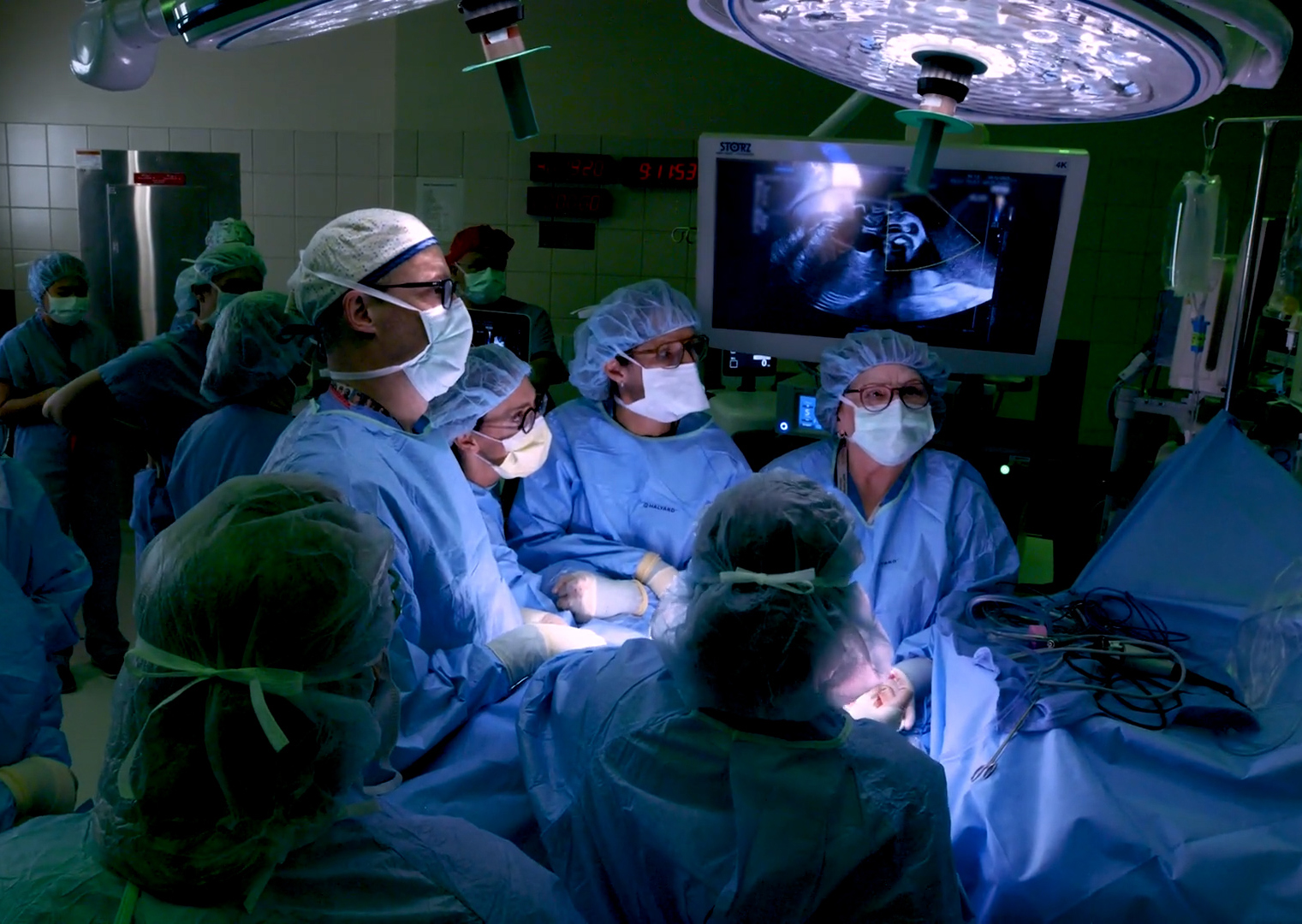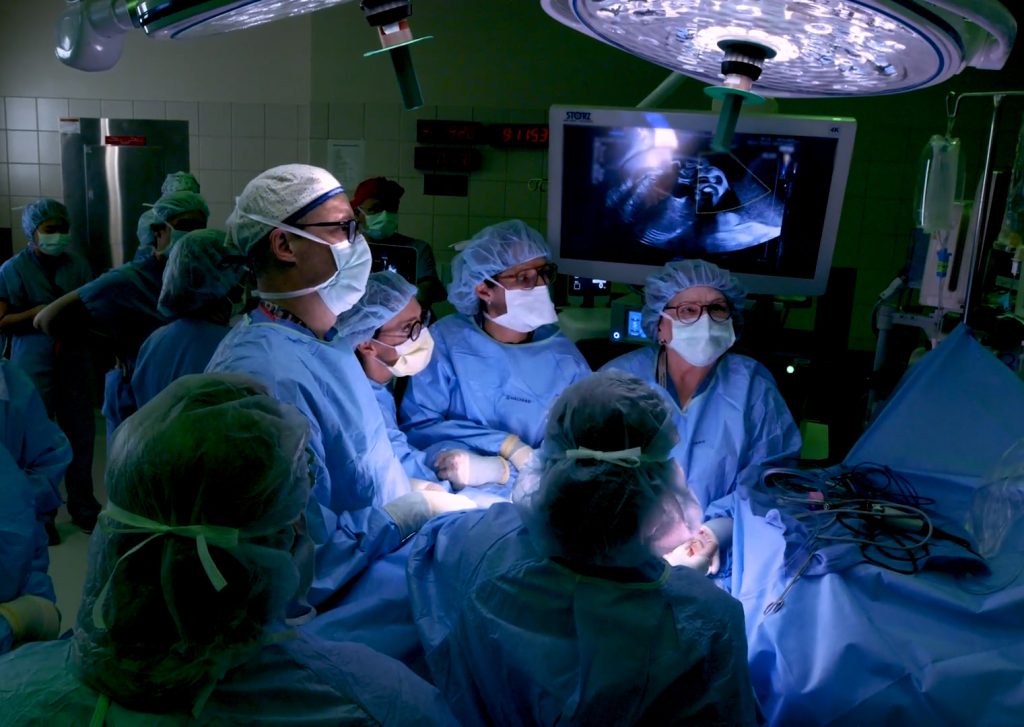
A new, less invasive procedure at Intermountain Health Primary Children’s Hospital is helping repair spina bifida while babies are still in the mother’s womb.
Now, they are performing the procedure using an innovative fetoscopic surgery method in which they only make three small incisions in the uterus, which is better for both mom and baby.
Repairing spina bifida while still in the womb greatly decreases the possibility of physical and cognitive complications later in life and allows mothers to have lower risk pregnancies in the future. This advancement is also allowing families to receive care in Utah without having to travel to other parts of the country for the treatment.
“Using this method we only have to make three small incisions on the uterus, and we use a camera along with small tools to repair the baby’s spine,” said Stephen Fenton, MD, a pediatric surgeon at University of Utah Health and Intermountain Health Primary Children’s Hospital. “Because we don’t have to make a larger incision on the uterus it gives the mother the opportunity for a regular delivery this pregnancy, as well as in the future.”
Spina bifida is a congenital neural tube defect occurring when the spinal column fails to close completely during the first month of pregnancy. Spina bifida is the most common permanently disabling birth defect in the United States, affecting approximately 70,000 to 166,000 babies annually.
For more than four years surgeons at the fetal center have been repairing spina bifida with open in-utero procedures which includes making a larger incision on the uterus. Using the fetoscopic method reduces the long-term for complications for the mother, while providing an excellent repair for the fetus.
“Even when we use this new surgical method it still takes a large team of caregivers in the operating room to make sure mom and baby are doing okay and being ready for any situation that could come while doing this complex procedure,” said Dr. Fenton. “The team has done an incredible job of training and preparing everything that is required for this new method, and we are already seeing incredible results thanks to their efforts.”
In May 2025, Angela Ibarra Garia of West Jordan, Utah, was the first patient in Utah to undergo fetoscopic surgery to repair her child’s spina bifida in the womb.
“I was definitely nervous about undergoing the surgery but I’m just happy to see technology has gotten to a point where we have the option,” said Garia.
The procedure was a success and six weeks later Angela gave birth to her daughter Daniela at University of Utah Hospital where her team could continue to monitor mom and baby.
Her daughter, Deniela, does need physical therapy to help with some of the issues in her lower body, but Garia is hopeful she’ll continue to make progress.
Since May, surgeons at Intermountain Primary Children’s Hospital have performed eight spina bifida repair procedures using new the fetoscopic tools, which is more than the previous two years combined using the previous method.
Maddison Vance of West Jordan, Utah, was another early patient to get this new procedure.
She found out at her 20-week appointment that her daughter had spina bifida and could be eligible for the repair. She didn’t even know this type of surgery existed and that it was available at Intermountain Primary Children’s Hospital.
“I couldn’t be more grateful that this surgery was available and only being 30 minutes from our house has made follow up care easy,” said Vance. “Our daughter, Jaycie, is now four months old and hitting all her milestones, she’s our most special girl who we love so much.”
Before these fetal surgical options were available in Utah, some families would skip getting the procedure because of the burden of traveling far from home to receive treatment.
Doctors note that these fetal procedures aren’t a cure for spina bifida but can help reduce fetal complications while giving children better function throughout their life.
In the past a child may have had developmental delays or be bound to a wheelchair, and now thanks to these advancements may be able to walk under assistance with normal brain function.
“This type of surgical method has only been around for about a decade, so we still have a long way to go to see the long-term impact, but we’re exciting by the initial outcomes and it’s giving another level of hope to families,” said Dr. Fenton.
The Grant Scott Bonham Fetal Center is a collaboration between Intermountain Primary Children’s Hospital and the University of Utah Health and is a result of Intermountain Health’s Primary Promise campaign, which raised more than $642 million dollars to help build the nation’s model health system for children.
For more information on the Grant Scott Bonham Fetal Center at Intermountain Primary Children’s Hospital, click here.
About Intermountain Health
Headquartered in Utah with locations in six states and additional operations across the western U.S., Intermountain Health is a nonprofit system of 34 hospitals, approximately 400 clinics, medical groups with some 4,600 employed physicians and advanced care providers, a nonprofit health plan called Select Health with more than one million members, and other health services. Helping people live the healthiest lives possible, Intermountain is committed to improving community health and is widely recognized as a leader in transforming healthcare by using evidence-based best practices to consistently deliver high-quality outcomes at sustainable costs. For up-to-date information and announcements, please see the Intermountain Health newsroom at https://news.intermountainhealth.org/. For more information, see intermountainhealth.org/ or call 801-442-2000.