
Commsignia & University of Michigan to demonstrate control of autonomous cars using V2X technology
Project to control the motion of an autonomous vehicle using only V2X information communicated from an object undetected by onboard lidar, radar or camera technologies.
Santa Clara, CA, USA (PRUnderground) June 14, 2017
Sensor technologies such as lidar, radar and cameras provide numerous advantages to automakers looking to increase the safety of ground vehicles. An automated vehicle can use sensors, decision-making software and control algorithms to perceive its immediate environment and respond to traffic scenarios just like humans. However, these onboard sensors, no matter how sophisticated, are limited as they can only see what is in their line of sight. So, just like humans, poor weather conditions or challenging traffic scenarios, such as vehicles hidden by curves or obstacles, can hamper the line of sight sensors and create potentially dangerous situations.
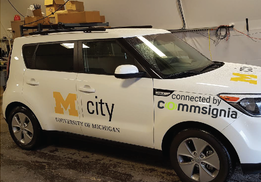
The research group headed by Professor Gabor Orosz at the University of Michigan is collaborating with Commsignia Inc (Santa Clara), a technology leader in the field of connected car (V2X, Car2X) applications, to extend the capabilities of connected automated vehicles (CAV). This project will demonstrate the ability to control the motion of a CAV based on information from a source beyond the line of sight that cannot be detected by onboard lidar, radar or camera technologies. The project is supported by Mcity, a public-private partnership between industry, government, and academia established to improve mobility, where Commsignia Inc is an affiliate member.
The V2X connectivity is based on secure dedicated short-range communications (DSRC IEEE 802.11p) that shares sensor and vehicle data between vehicles and the surrounding infrastructure. In this project, Commsignia is supplying the Onboard Unit (OBU) as well as it’s end-to-end US DOT SCMS PKI compliant V2X software stack.
Professor Orosz stated “My team consisting of well-trained and highly motivated graduate students is laying down the foundations of connected mobility. Realizing the key principles experimentally is essential to be able to demonstrate the benefits of connected automation. The versatile functionality and high reliability of Commsignia onboard units allows us to implement our control algorithms that can make the roads of the future safer.”
*The benefits of safety and awareness of V2X as a sensor – with its ability to “see around the corner” – have already been proven beyond doubt as a means to providing relevant and reliable early warning messages for advanced driver assistance systems,“ commented Mr Jozsef Kovacs, Commsignia CEO. “Commsignia is proud of its association with Professor Gabor’s research group in a project that is taking a first evolutionary step for V2X towards complementing the self-driving car with connectivity-based control algorithms for a safer tomorrow.”
The demonstration will be held in Mcity on June 21st.
Distributed via PR Underground